The four red flags: how we decide which teeth are at high risk of fracture and caries
Every practice has a set of teeth nobody is treating.
A wide amalgam, twenty years old. No pain, no obvious caries, a bitewing that looks acceptable. You tell your patient that it looks stable and that you will keep it under observation. Next month, or next year, that patient attends an emergency appointment because the tooth fractured while they were eating a piece of bread.
I had a lot of those teeth. Not because I could not treat them, but because I had no objective way of working out which ones were actually in trouble and which were genuinely fine.
The four measurements
These are the criteria every clinician uses at The Gentle Touch (four dentists and four dental therapists) on every structurally compromised tooth. Same language, same thresholds, whoever sees the patient.
01. Isthmus width greater than 2 mm.
Measured horizontally across the occlusal isthmus. Once you are past 2 mm, the tooth flexes measurably more under load, and the wider it gets, the more it flexes.
02. Remaining cusp thickness less than 3 mm.
Or 2 mm where the cusp is a holding cusp, or is no longer in occlusion. Cusps cope far better with vertical loading than with lateral loading, so a guidance cusp needs more structure to support it.
03. Box vertical depth greater than 4mm
A deep box means less structure remains, so the cusps flex more. It also indicates the restoration will be demanding: deep margin elevation, a high configuration factor, a poorer dentine substrate, and difficult isolation. This increases the urgency and complexity, so it is worth knowing before you start rather than halfway through.
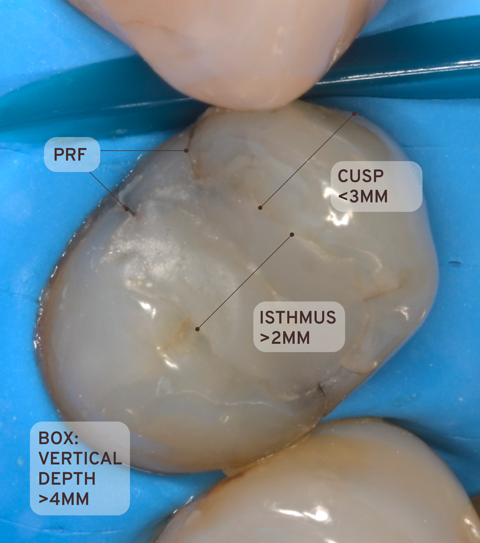
04. Peripheral rim fracture present.
This is damage the tooth has already sustained. A fracture at the peripheral rim usually means a crack has extended into dentine, and that changes how you manage the treatment.
This is worth knowing
Magne and Oganesyan (2009) measured how much a premolar widens under a 150 N load, which is an ordinary chewing force.
| An intact premolar: 2.7 microns. With an MO cavity: 5.0 microns. With an MOD cavity: 179.4 microns.
There is no gradual slope between losing one marginal ridge and losing two. There is a cliff.
That single set of numbers is why I stopped treating a wide two-surface cavity and a wide three-surface cavity as roughly similar problems. They are not remotely similar. And it is why I will always preserve a sound marginal ridge, always.
The encouraging half of the finding is what happens when that same MOD cavity is bonded back properly: 6.9 microns. Not quite the same resistance to flexing, but close. Adhesion is not just holding the filling in. Done well, as Davey Alleman puts it, it is connecting the tooth side to side, front to back and top to bottom.
Fracture and caries are the same problem
I used to think of fracture risk and secondary caries risk as two separate assessments. On a structurally compromised tooth, they are not.
Weakened cusps flex under load. That flexing cracks the cusp, and the same movement opens micro gaps between tooth and restoration. Bacteria seep into the gaps. One
mechanism, presenting two different risks.
It is what finally explained something that used to puzzle me: secondary caries in patients whose oral hygiene is excellent, margins that look reasonable and no signs on the radiographs. It was never really about their brushing or diet. It was about the tooth flexing.
Don’t forget the occlusion
The flag count tells you how vulnerable a tooth is. Occlusal load tells you how quickly it will get into trouble. Lots of situations to look out for: premature contacts, a lone standing molar, crossbite, occlusal trauma. If, however, the opposing tooth is now not present, or there is a denture tooth opposing it, you can put its urgency down the list.
If you see a tooth that you are not sure about, that is what the WhatsApp number is for. 07898 738646.
Any questions, get in touch! Thanks, Amber